When many people hear the term “economy,” it brings to mind visions of Wall Street, factories, large international businesses, or even the local hotel or casino. We have become accustomed to men in suits discussing the “economy” on television, referencing policies and decisions that can feel foreign and removed from our daily lives, let alone our cultural and spiritual lives. This distancing of people from economic understandings and decision-making stands in the way of our inspired and empowered Nationhood.
The “economy” simply means the way a people provide for themselves’ – both the act of gathering resources and the social agreements about how resources are distributed. Every Indigenous Nation had a traditional economy, a way of gathering and distributing what we needed to live and thrive, that was connected to extensive trade routes across the Americas, allowing exchange of the gifts of the land, knowledge, language, and culture.
These economies developed based on countless generations of learning from our homelands and each other, learning to care for the beings that give us life while ensuring their continuance. These economies also reflected an understanding that our homelands are living beings to be engaged with in good relationship in order to receive the blessings of abundance, and the importance of keeping good relations and resource distribution among community members.
Every Indigenous Nation had a traditional economy, a way of gathering and distributing what we needed to live and thrive, that was connected to extensive trade routes across the Americas, allowing exchange of the gifts of the land, knowledge, language, and culture.
Dr. Ron Trosper, Salish/Kootenai tribal member and economic researcher, noted that thriving traditional economies share three common principles: 1)Permanence within a homeland and the understanding that, even though families may have a recognized right to harvest within certain territories, lands remain a collective responsibility; 2) Deep emphasis on reciprocity and generosity with the land and each other; 3) A system of accountability for leadership. Harvesting leaders were given those positions through demonstration of their ability to care for the land. Leaders of resource distribution were given their role through demonstrated graciousness and honor, and there were systems of accountability if their behavior violated this.
Forced Dependency and State Economies
When settlers arrived and colonization began, our economic systems were targeted for disruption and destruction. Removing a peoples’ means of providing for themselves is a cunning way to suppress and control them. George Washington famously led the burning of Haudenosaunee seed houses. The United States encouraged the slaughter of buffalo to destroy the ability of the Plains Nations to provide for themselves. And in California, settlers methodically destroyed Oak trees that the people depended upon.
A state of dependency was intentionally created, with the Nations having to look to their colonizers for survival assistance.
As a result of history, our economies are now modeled after the colonial economics of globalized capitalism, a system based on large scale resource extraction, privatization, and commodification of the beings that give us life. As we seek to understand our histories and pathways forward, it is important that we understand the different economic systems that have been used internationally; capitalism, communism, and socialism.
As a result of history, our economies are now modeled after the colonial economics of globalized capitalism, a system based on large scale resource extraction, privatization, and commodification of the beings that give us life.
Capitalism involves private ownership of the means of production and a model of continuous profit growth. It originated in Europe as a result of the removal of people from land, creating dependence, wage labor, and competition.
Communism is the communal ownership of the means of production. Under ideal communism, people would receive equal benefits of the work they do
Socialism involves societal ownership of the means of production, and the power of workers to make decisions about and directly benefit from their work.
No country in the world operates under a “pure” form of any of these economic systems. Capitalism has accompanied colonialism to become the dominant global economic system. This has created immense wealth for a few families in a few countries, leaving a legacy of social and environmental degradation, militarization and violence.

Our Indigenous governments, seeking to recover from dependence, now sometimes engage in the same exploitive economic practices used to decimate our peoples, causing intense internal conflict. We have also been encouraged to make ourselves attractive to capitalist investors. Collective land ownership and community decision-making processes are not attractive to investors and many Nations are left feeling like they have to set their cultural responsibilities and spiritual values aside as they pursue economic opportunities for their people.
In response to the devastation of colonial economics, there is a powerful international movement underway to create alternatives. As this work unfolds, it is vital to remember that economic systems are only as good as the values, responsibilities, and community agreements that govern them.
Capitalism, communism, and socialism have all been abused by people who have had no mechanism to hold them accountable. These systems have also historically operated outside of an understanding of reciprocity with a living world, traditional teachings, or spiritual responsibilities, preventing them from being truly sustainable.
We have to be brave enough to think beyond the boundaries of what we have been told is possible. As Albert Einstein said, “You can’t solve a problem with the same kind of thinking that created it.”
Re-Emerging Seeds for our Thriving Future
Our Nations, while still in struggle, are also places of visionary creative possibility. Turning to our communities, we can see the places where our traditional economies continue: in the small trade we conduct with each other, in our potlatch, in our traditional harvest, and the sharing of that harvest. In the trade of salmon for car repair, or the trade of berries for new skirts.
Our stories that hold teachings of how to live, our clan systems, and our responsibilities still continue, even if limited or diminished. How does this apply to economic development that will support our people in this world of cash and markets? I suggest the following first steps to integrate traditions with modern Indigenous economies:

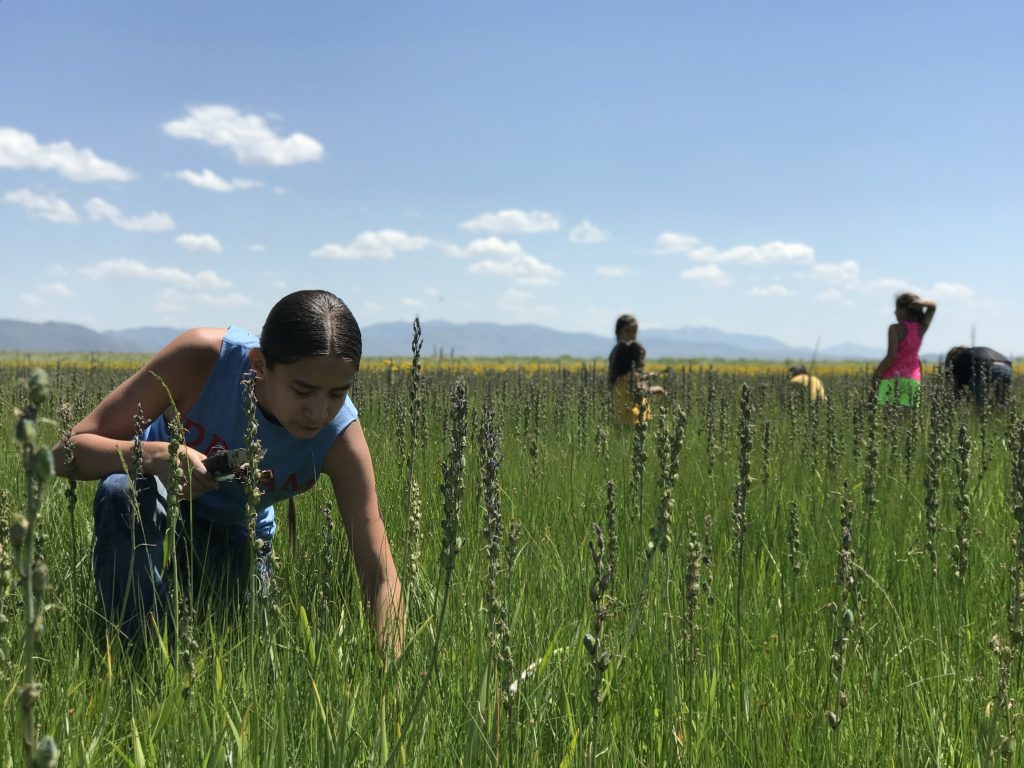
1. Re-value and re-centralize our traditional practices. Harvest of our foods and materials, and the creation of products that come from our communities serve an economic and a culturally revitalizing purpose, connecting us to our ancestors and descendants, our teachings, and a creative ongoing relationship with our homelands.
2. Re-centralize the practical needs of the people. What do we need to thrive? How can we provide for these needs in as local a manner as possible? What products do we have to trade for? Are there other Indigenous people we can trade with? Local, bioregional businesses or co-operatives we can trade with? The more people directly experience the impacts of economic decision-making, the less likely folks will make decisions that are harmful to the land or their neighbor.
3. Look to our lands with loving and relational creativity. What abundance does the land offer? What can the land create/regenerate? What can we give back to the land to cultivate the regeneration of life? These questions should underpin new economic development ideas.
4. Look to our people with loving and relational creativity. What creative visions and skills do we have? What can we create/regenerate? What reciprocal relationships can be encouraged in community to allow our people to be supported in their work? These questions should also underpin new economic development ideas.
5. Understand the importance of boundaries and the falsity of “economic growth.”We all have traditional stories that encode the boundaries we need to live within in order to perpetuate life, and our traditional values of moderation. These are teachings to consider deeply.
6. Explore ways of making your teachings and spiritual values the core guiding principles of any economic idea. Explore ways of re-integrating traditional resource distribution practices, as well as governance and community accountability mechanisms. Understand that re-integration of our practices will likely take some time, mistakes, and patience.
7. And, above all, remember that although we have to engage with markets and capitalism to a certain extent, we can do so on our own terms, without buying into destructive mentalities. No one can do this work for us – we are the ones with the solutions to our challenges. We can also learn from and share ideas with other Indigenous peoples and Nations who are exploring ways of rebuilding our economies.
It is vital to remember that economic systems are only as good as the values, responsibilities, and community agreements that govern them.
Tweet
With creative determination and relationship building, we can model the systemic transformation of trade and economy from one based on the exploitation of our ecological and human relations, towards one based on care, reciprocity, and the regeneration of life. And it is happening!
We are busy renewing traditional agriculture and revitalizing old trade routes. We are growing our reservation-wide networks, supporting one another with skills, products, and services. We are imagining new businesses based on regenerating the health of the land, and we are building infrastructure that reflects our responsibilities to Creation and our connection to our families. We live in a time of transition, creativity, and change, and the future looks beautifully Indigenous!